1971
Dual Four-band Parametric Equaliser
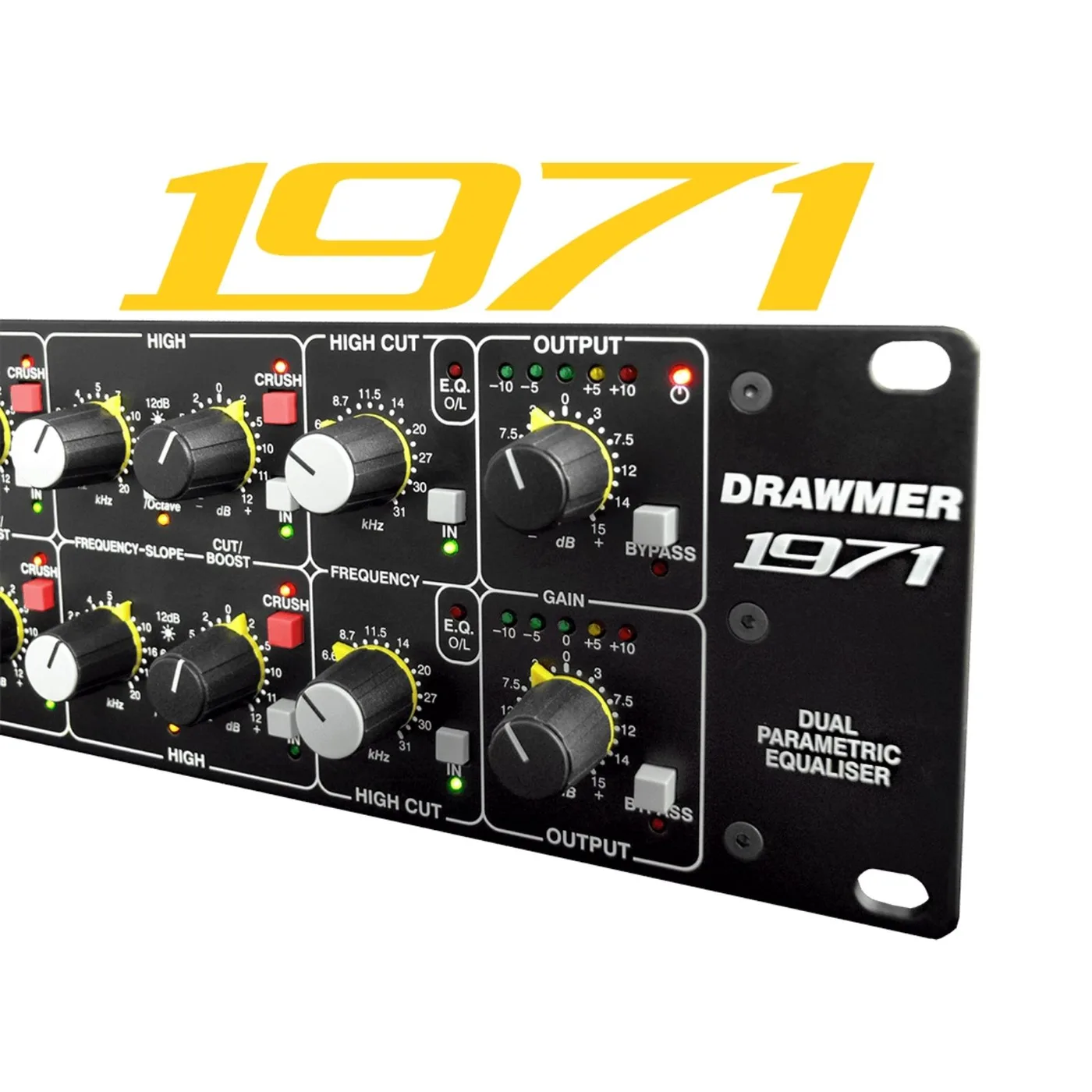
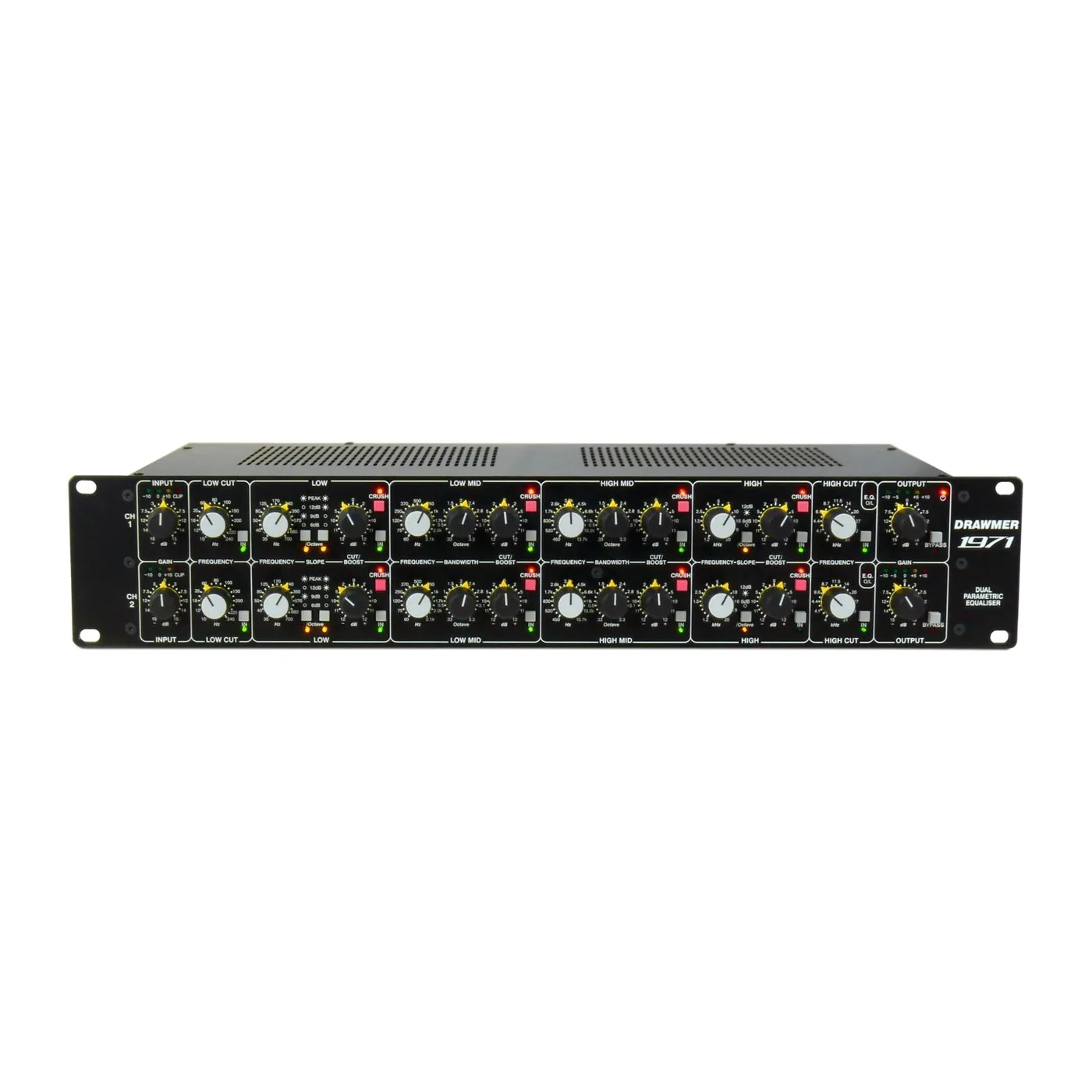
The Drawmer 1971 is a dual-channel, four-band parametric equalizer designed to deliver precise tonal control alongside rich analogue character. Combining stepped, recall-friendly EQ with Drawmer’s unique CRUSH harmonic saturation circuit on every band, it offers both corrective accuracy and creative colour in a single unit.
With fully parametric bands, variable bandwidth on the mid sections, sweepable high-pass and low-pass filters, and selectable slope control, the 1971 adapts easily to mixing, mastering, and sound-design tasks. From subtle refinement to bold, harmonically driven shaping, it provides engineers with a versatile analogue EQ that excels in both precision and personality.
Vintage Character & Harmonic Control
The Drawmer 1971 is a dual-channel, four-band parametric equalizer that balances precision with unmistakable analogue warmth. It delivers the accuracy required for subtle tonal refinement and fast recall, while offering the ability to sculpt bold, musical curves that bring depth and character to any source.
Central to the 1971’s identity is the CRUSH circuit — a unique harmonic saturation stage available on every EQ band. By introducing controlled distortion, CRUSH recreates the feel of driving a vintage console or tape machine. From gentle colour to assertive grit, it adds weight to drums, presence to vocals, and sheen to full mixes.
Versatile & Accurate Equalisation
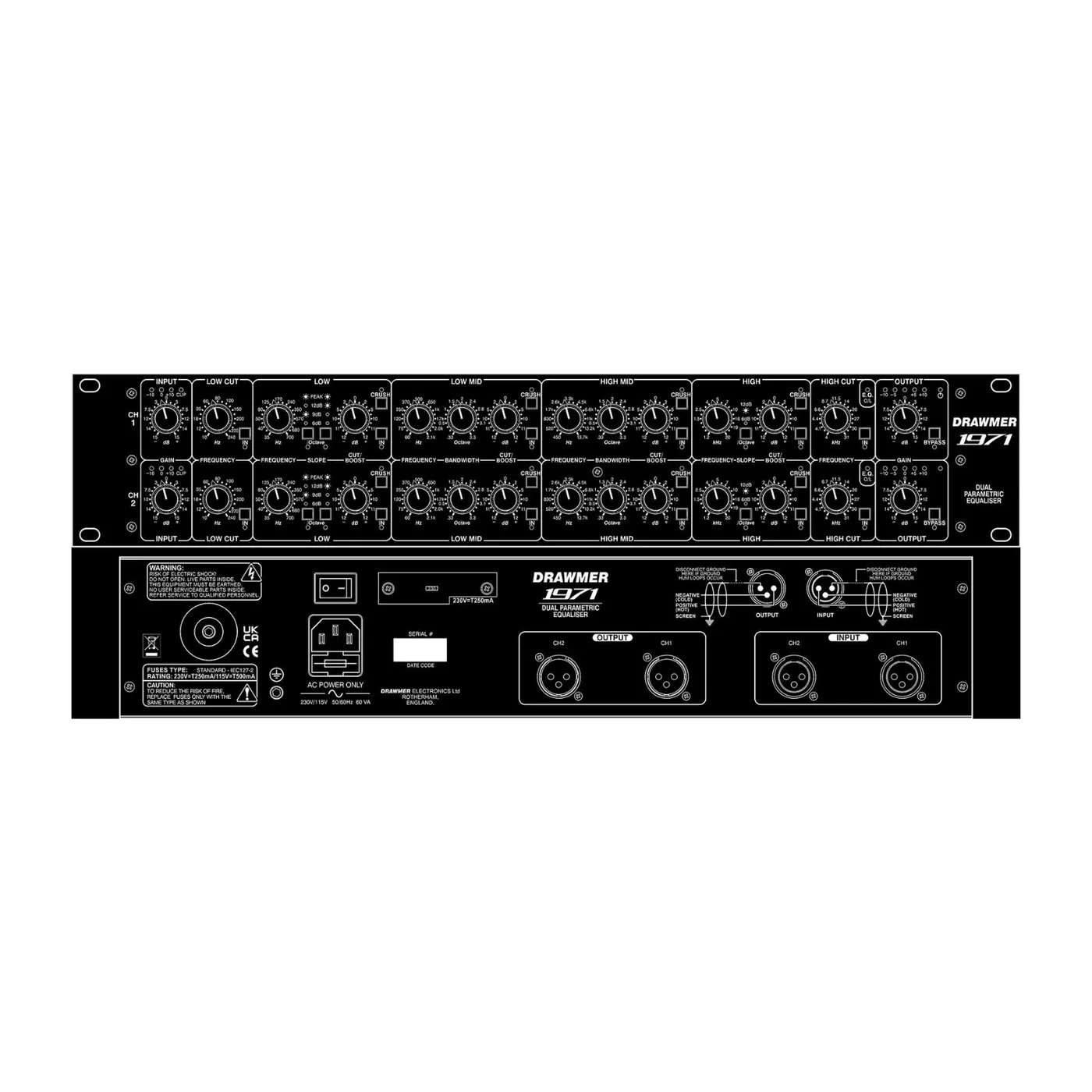
Each channel features four fully parametric EQ bands with variable frequency selection and ±12 dB of cut or boost. Precision-stepped potentiometers ensure consistent, repeatable results, making the 1971 ideal for workflows where recall and stereo accuracy matter.
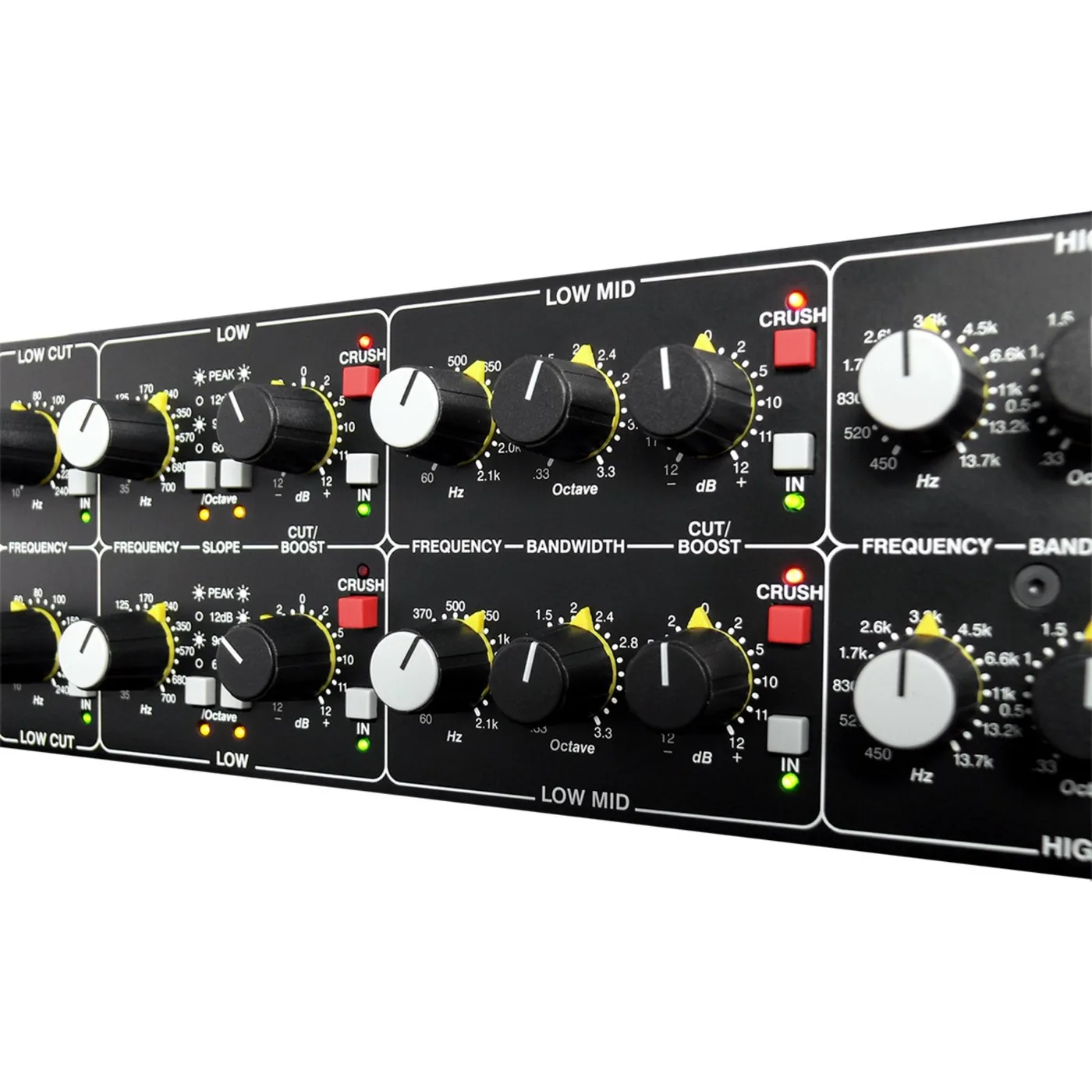
The two mid bands include continuously variable bandwidth control, allowing anything from tightly focused corrective EQ to wide, natural tonal shaping. This flexibility makes the 1971 equally effective for problem-solving, enhancement, or creative sound design, while retaining the musical response of a true analogue circuit.
Filters & Slope Control
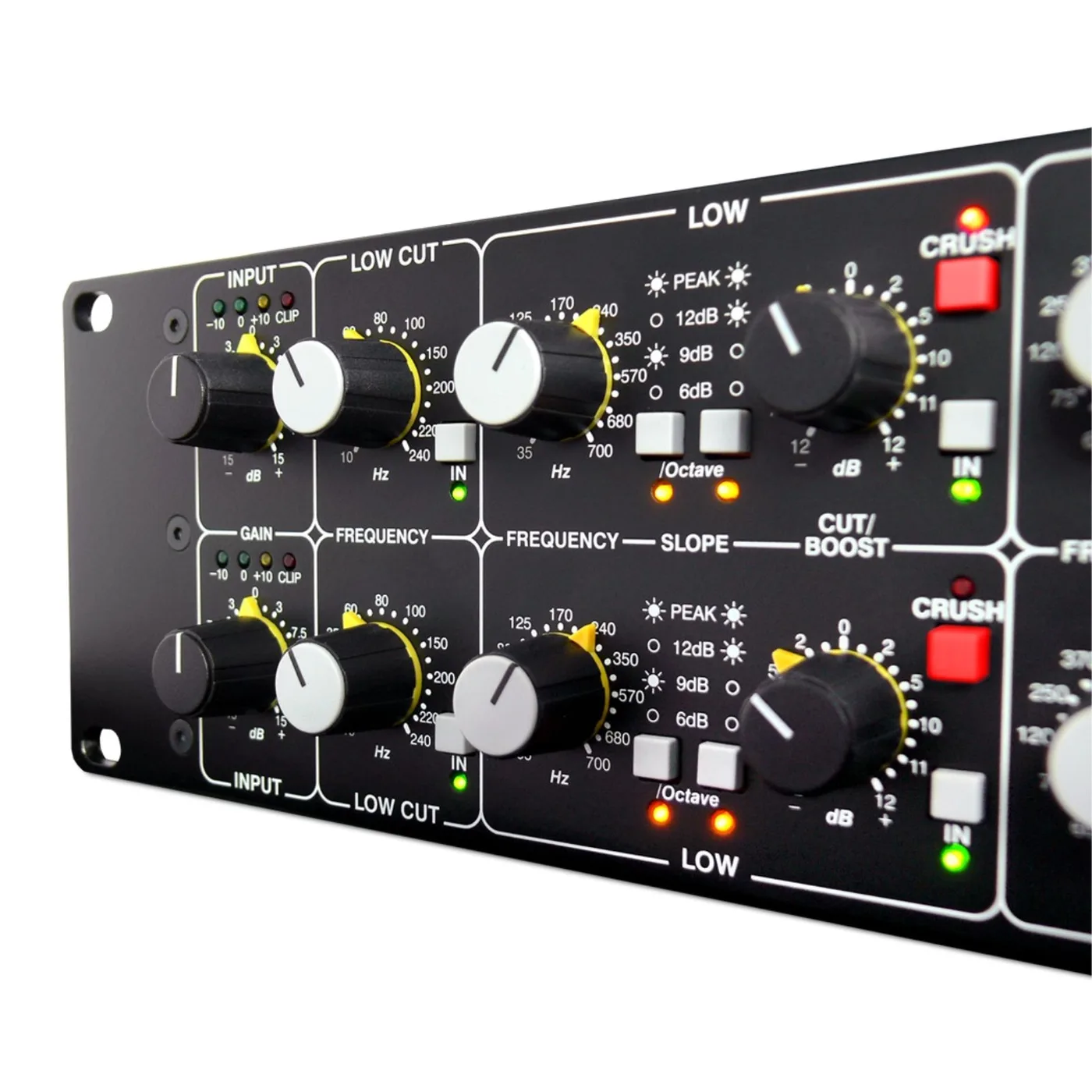
Fully variable high-pass and low-pass filters provide precise control over unwanted extremes. The low-cut filter sweeps from 10 Hz to 240 Hz, while the high-cut filter ranges from 4 kHz to 31 kHz, enabling accurate removal of rumble, hiss, or excess energy without compromising musical balance.
The low and high bands also feature selectable slope control, offering 6, 9, or 12 dB per octave responses chosen for their smooth, musical behaviour. A dedicated Peak mode adds a focused boost at the knee of the low filter, reinforcing punch and impact — particularly effective on kick drums — while still filtering subsonic content.
CRUSH Harmonic Saturation
CRUSH is fully progressive: the more EQ boost applied, the stronger the harmonic saturation becomes. In the low frequencies it fattens kick drums, bass, and toms; in the midrange it adds warmth and density to vocals, guitars, and percussion; and at the top end it introduces shimmer, air, and presence.
An instant CRUSH bypass allows easy A/B comparison, while the EQ overload LED provides clear visual feedback when applying heavier boosts. With CRUSH engaged, the 1971 becomes more than an equalizer — it is both a precision corrective tool and a powerful source of vintage analogue colour.
Features
- Dual-channel, four-band parametric equalizer delivering classic analogue character with modern control
- Vintage warmth with contemporary precision suitable for mixing, mastering, and sound design
- Stepped potentiometers provide accurate, repeatable settings and reliable recall
- Fully variable low-cut and high-cut filters for precise removal of unwanted frequencies
- Continuously variable bandwidth on both mid bands for focused corrective EQ or broad musical shaping
- Selectable slope and Peak modes add punch, focus, and musical emphasis to low frequencies
- Independent CRUSH saturation on each band introduces controlled harmonic enhancement
- Adds harmonics, presence, and analogue colour to individual tracks or full mixes
- True hardware bypass on each band allows instant A/B comparison
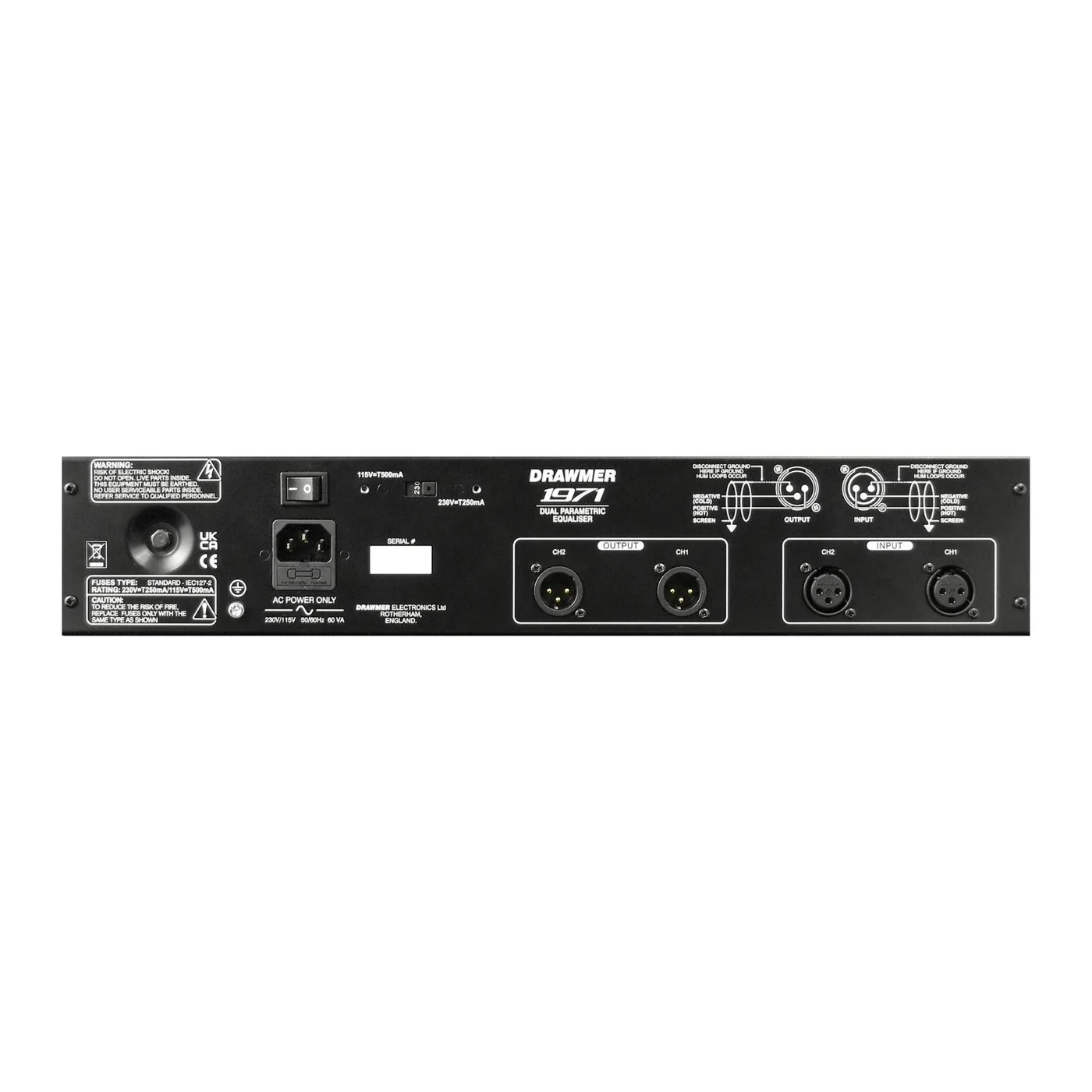
- Low-hum toroidal linear power supply with rear-panel voltage selector
- Rugged steel chassis with aluminium front panel for long-term reliability
- Designed and handmade by Drawmer in the United Kingdom
Specifications
| Input Impedance | 20k Ohms or greater |
| Maximum Input Level | +21 dBu |
| Output Impedance | < 100 Ohms |
| Maximum Output Level Into 10k Ohms load |
+21 dBu |
| Frequency Response | 20 Hz – 20 kHz ±0.5 dB |
| Crosstalk @ 1 kHz |
< –90 dB |
| Distortion (THD & Noise) @ 1 kHz, 0 dB at line input |
0.003% |
| Mic EIN | –130 dB |
| Power Requirements |
115 V or 230 V at 50–60 Hz 30 VA |
| Fuse Rating @ 230 V |
T250 mA |
| Fuse Rating @ 115 V |
T500 mA |
| Fuse Type |
20 mm × 5 mm, Class 3 Timed-Blo, 250 V working Conforming to IEC 127-2 |
| Case Depth |
270 mm |
| Case Width |
482 mm |
| Case Height |
88 mm |
| Weight | 4.2 kg |
In the interests of product development, Drawmer reserve the right to modify or improve specifications of this product at any time, without prior notice.